Dr Corrigan
The Pale HorseDr Corrigan is a physician, a police contact in the inquiry into Father Gorman’s murder, and a long-unseen friend of Mark Easterbrook. His appearances are brief, but they join two strands of the investigation: the medical questions surrounding the murdered priest and the personal conversation through which Mark first learns about the case. The story gives him no independent resolution or extended arc; his importance lies in how he moves information between the police inquiry and Mark.
Identity and Introduction
Dr Corrigan first appears in the Divisional Detective-Inspector Lejeune’s room, entering in a chatty manner while whistling Father O’Flynn. He tells Lejeune that he has completed a task concerning the priest, and Lejeune immediately asks for the result. The exchange presents Corrigan as a doctor whose work is relevant to the investigation, though the available conversation does not disclose the findings themselves. His casual manner contrasts with the gravity of the murder being discussed, placing professional business inside an unceremonious conversation between colleagues.
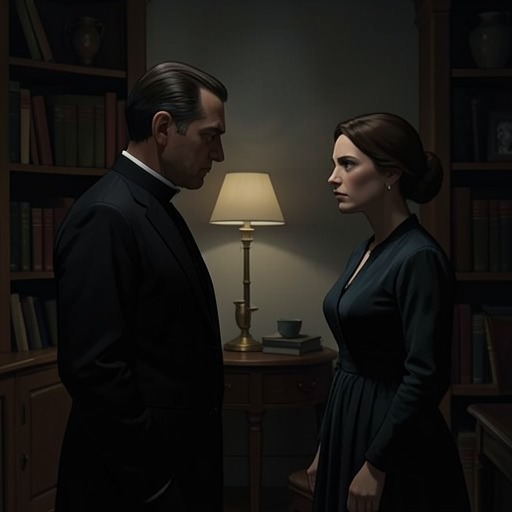
In another exchange with Lejeune, Corrigan asks what he makes of the case. Lejeune replies that it is important, then considers the difficulty raised by the dying woman’s information: whether Father Gorman would have written down names if he had received them under the Seal of the Confessional. The question locates Corrigan within the inquiry’s early uncertainty. The issue is not simply what the priest learned, but how the information could have passed from a private confession into a written list that might help identify a crime.
Reunion with Mark Easterbrook
Corrigan’s connection to Mark emerges unexpectedly. Mark, carrying three watercolors he has chosen, comes out of 49 Ellesmere Square and nearly collides with someone arriving at the front door. Recognizing the man, he turns back; Corrigan recognizes him in return. Their exchange establishes that they had been friends during their Oxford days and had not met for fifteen years or more. The chance encounter restores an old acquaintance at the moment when the murder investigation is about to enter Mark’s life.
The reunion is not presented as a long-delayed meeting arranged for the investigation. Its accidental setting matters: Mark is leaving with paintings under his arm when he recognizes Corrigan on the steps. The ordinary interruption becomes the route by which news of Father Gorman’s death reaches him. Their earlier friendship supplies a basis for frank conversation, but the narrative does not elaborate on their student years or suggest that they have remained close during the intervening period.
Part in Mark’s Discovery of the Case
During their conversation, Corrigan asks Mark whether a woman could plausibly have been blackmailed. Mark is astonished by the question and asks what it concerns. It is through this exchange that Mark first hears the circumstances of Father Gorman’s murder. The shift from an abstract question about blackmail to the murder investigation gives the scene its function: Corrigan does not merely report a case; he gives Mark a reason to ask what evidence exists and how the inquiry is proceeding.
Mark’s immediate response is to ask about the list of names. That detail connects their conversation to the central investigative problem already being discussed with Lejeune: the priest may have recorded information disclosed by a dying woman. The list makes the murder more than an isolated death, suggesting that the priest’s last visit and the identities written down may matter to a wider pattern. Corrigan’s role is to open this line of inquiry for Mark, not to provide a final explanation of it.
Relationships and Narrative Role
Corrigan’s relationships in the evidence are defined by trust and practical exchange. With Lejeune, he can enter the detective’s room casually, report that he has completed work concerning the priest, and ask for the inspector’s assessment of the case. With Mark, the old Oxford friendship allows the investigation to surface in conversation without a formal introduction. These links place Corrigan between professional investigation and private life, while leaving the detailed terms of his work and his later involvement unstated.
His narrative function is therefore connective rather than that of a principal detective. He helps frame the medical dimension of the case, participates in discussion of the priest’s list and confession, and becomes the person through whom Mark first learns that Father Gorman has been murdered. The story’s movement from the police room to the chance reunion broadens the inquiry’s reach: information being examined by Lejeune becomes the beginning of Mark’s own investigation. Corrigan is a hinge in that transition, even though the evidence does not assign him the eventual solution.